
Updated October 2026
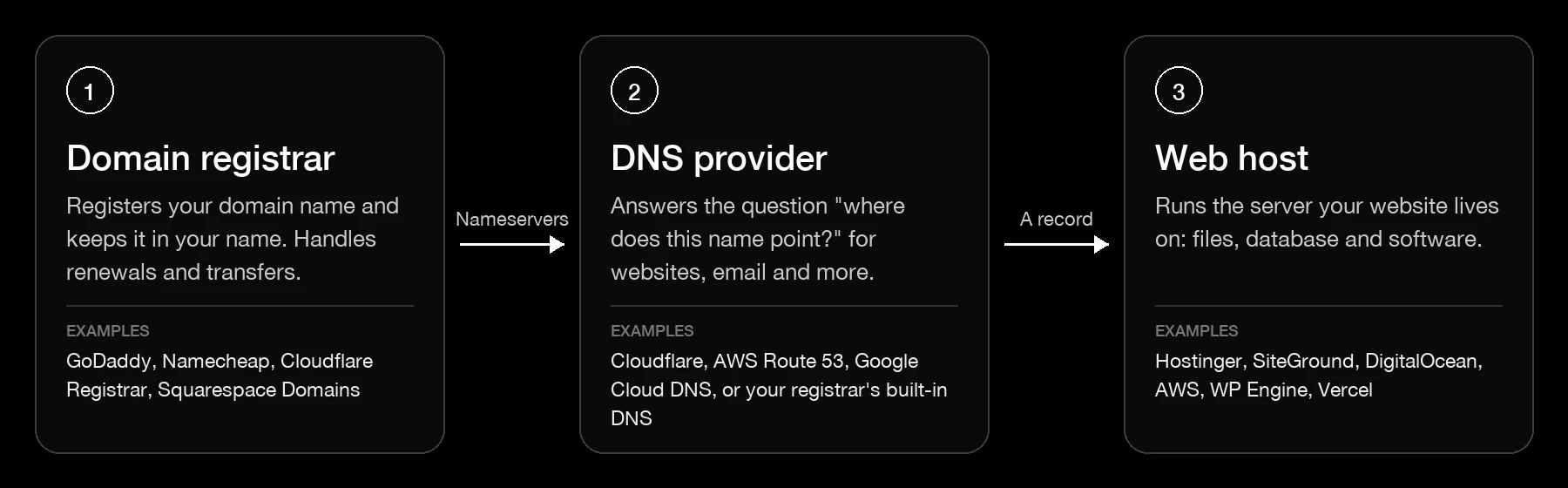
Three different services put a website online: a domain registrar, a DNS provider and a web host. They are often sold together by one company, which is why it all blurs into one. But they do three separate jobs, and knowing which is which saves a lot of confusion when something breaks or needs to be moved.
The three parties
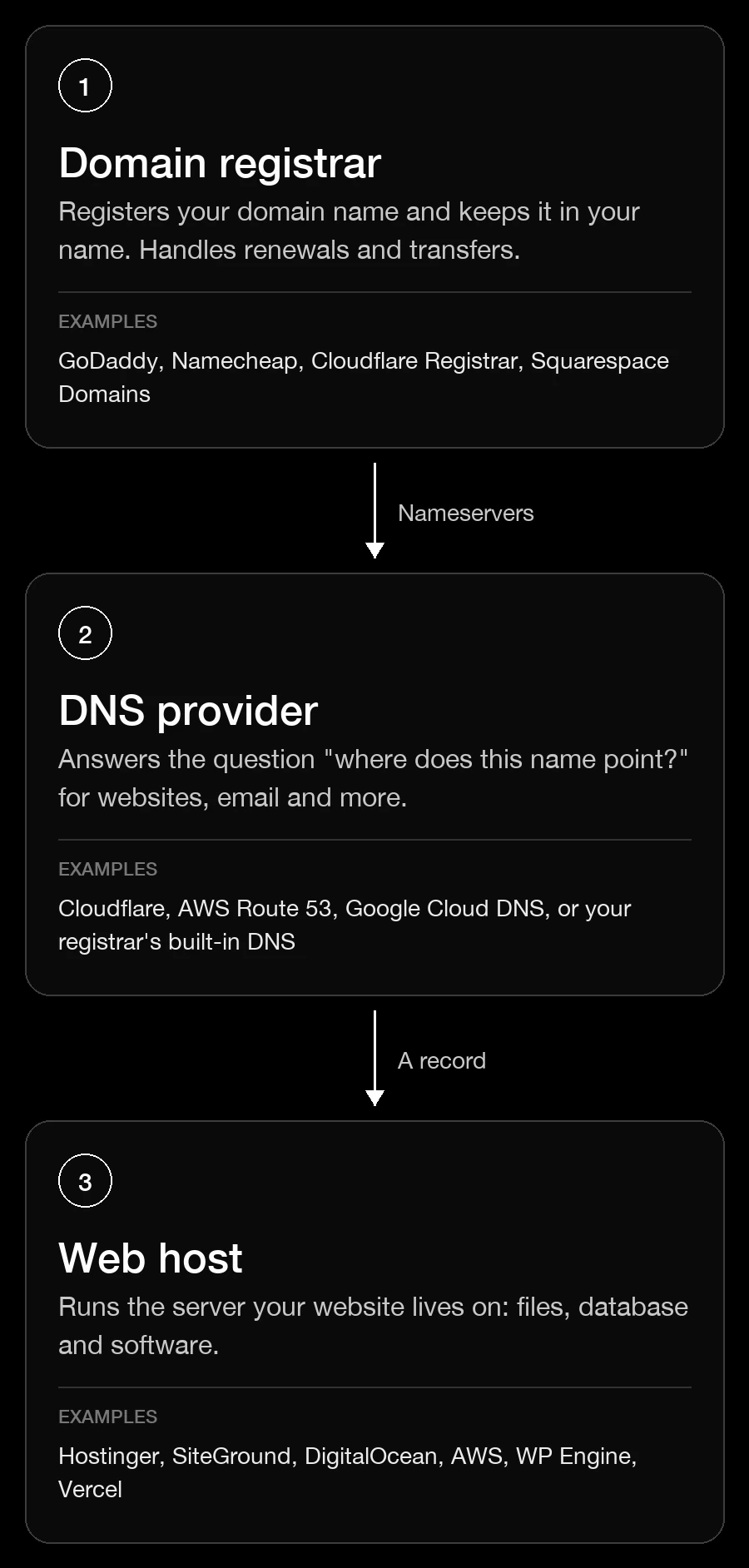
The domain registrar registers your domain name (like coderweb.in) and keeps it in your name. They deal with the registry for that ending, such as .in, .com or .org, and handle renewals and transfers. If a domain expires or changes owner, it happens here.
The DNS provider holds the address book for your domain. When someone types your address, DNS answers with where to go: which server delivers the website, which servers handle email, and so on. These entries are called records. Many registrars include basic DNS, and many people move it to a dedicated service like Cloudflare for speed and security.
The web host runs the server your website actually lives on, with the pages, files, database and software. This can be shared hosting, a VPS, a managed WordPress host or a cloud platform.
A single company can do more than one of these jobs, and some do all three. Vendors will often nudge you to bundle them. That is convenient, but it is worth knowing you can mix and match.
What it looks like in practice: coderweb.in
Here is our own domain. You can look up any domain the same way with a free WHOIS tool.
1. The registrar. A WHOIS lookup shows who the domain is registered with (for us, Endurance International Group) and when it expires.
2. The nameservers. The same lookup lists some “name server” lines. These say who the DNS provider is. Ours point to Cloudflare.
3. The records. At Cloudflare, the A record for coderweb.in points to an IP address. Because we use Cloudflare’s proxy, that address belongs to Cloudflare, which passes visitors on to our own server. The email (MX) records live in the same place and point to our email provider.
So three different companies are involved, and each one can be changed without touching the others.
Why changes sometimes take a while
- Web host changes (editing a page, updating your site) show up straight away.
- DNS record changes (for example, pointing your site at a new server) are cached by networks around the world for a set time called the TTL. It is often between 5 minutes and a few hours, and you can lower it before a planned move.
- Nameserver changes (moving DNS to a new provider) pass through the registry, so they can take longer. They often finish within a few hours but can take up to 48 hours.
When a change “isn’t showing”, you are usually just waiting for caches to expire. Checking from your phone on mobile data, or in a private window, often shows the new version sooner.
A few useful habits
- Keep your domain on auto-renew, with a working email address on the account.
- Turn on registrar lock and two-step login. Domain theft is rare, but painful.
- Before a site move, lower your TTL a day ahead and keep the old server running until the new one is confirmed.
In summary
The registrar owns the name, DNS decides where it points, and the host holds the website. Keep all three in accounts you control and you can change any one of them without disturbing the others.